How to Improve Critical Care Management Worldwide?

How to Improve Critical Care Management Worldwide? This question begins with an uncomfortable fact: survival often depends on location, not clinical severity alone. The 2023 WHO–World Bank Universal Health Coverage monitoring report estimated that 4.5 billion people lacked full coverage of essential health services in 2021. Critical care sits within this wider gap. It requires trained teams, reliable oxygen, monitoring, medicines, referral pathways, and electricity. A ventilator cannot compensate for an absent nurse. Nor can a guideline repair a broken supply chain. WHO’s 2022 Global Report on Infection Prevention and Control estimated that 15 in 100 patients in lower-income countries acquire infections during acute care. The figure was 7 in 100 in high-income countries.

Improvement therefore needs more than expensive equipment. It needs context-tested systems. The Surviving Sepsis Campaign’s 2021 guidelines support early recognition, timely treatment, and repeated reassessment. WHO’s Global Patient Safety Action Plan 2021–2030 also emphasizes learning, measurement, and safer systems. Practical progress may begin with basics: a stocked oxygen point, a visible escalation chart, and a nurse empowered to call for help. Training should include simulation, audit feedback, and local outcome data. Still, evidence is uneven. Many studies come from well-resourced hospitals, so universal claims deserve caution. Better processes do not automatically guarantee better survival. This limitation matters. Worldwide critical care management should combine rigorous evidence with bedside experience, transparent reporting, and sustained local leadership. Its success should be measured beside real patients, including those who never reach an intensive care unit.
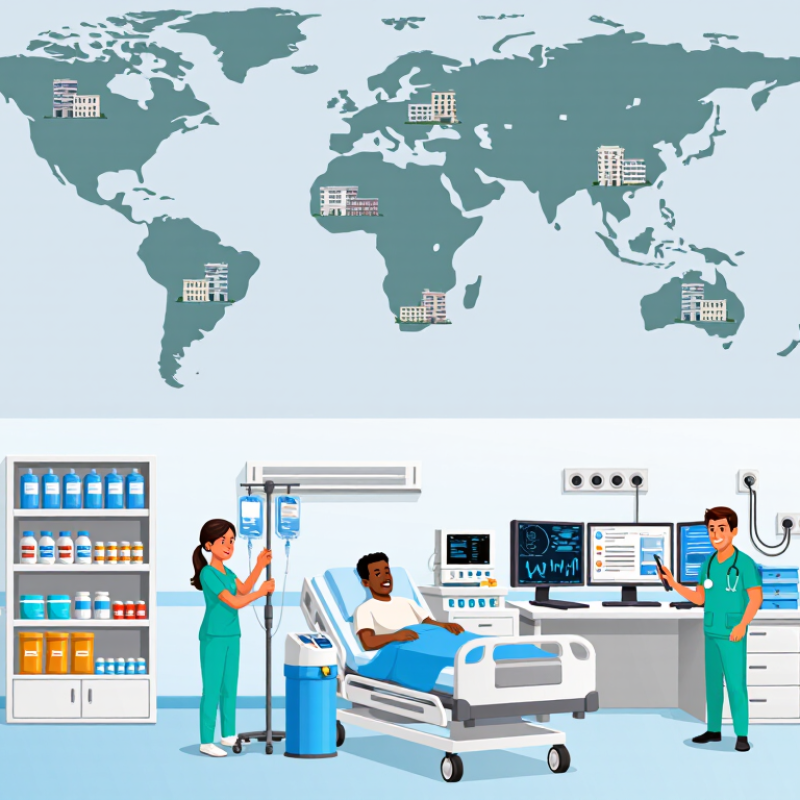
How to Improve Critical Care Management Worldwide?

Map Global ICU Capacity: From Fewer Than 1 to Over 30 Beds per 100,000

How to Improve Critical Care Management Worldwide?

Global intensive care capacity remains sharply uneven. Published international surveys report fewer than 1 ICU bed per 100,000 people in some low-resource settings, compared with more than 30 in better-resourced systems. A global review in Critical Care estimated roughly 2.7 ICU beds per 100,000 people in low-income countries, versus 25.8 in high-income countries. These figures are not perfectly comparable. Definitions, reporting quality, and seasonal capacity differ.

The gap is visible at the bedside. One hospital may have ventilators but no trained staff, while another has beds, monitoring, and round-the-clock specialists. The World Health Organization stresses that critical care depends on oxygen supply, infection prevention, reliable referral systems, and a skilled workforce. Bed counts alone can mislead. A spare bed without nurses is not real capacity. That distinction deserves more attention.

Tips: Map ICU beds, trained staff, oxygen systems, and referral times separately. Use national registries with shared definitions. Publish district-level data, including rural gaps. Build practical training for emergency teams and nurses. Protect maintenance budgets, not only construction funds. Test surge plans during routine drills, not only during crises.

OECD Health Statistics also shows wide variation among reporting countries, with some systems exceeding 30 critical care beds per 100,000 people. However, higher capacity does not automatically mean better outcomes. Excess beds can strain budgets, while too few beds delay treatment. A more useful target may combine population need, travel time, staffing ratios, and emergency readiness. Data quality remains imperfect, but ignoring the imbalance is worse.

How to Improve Critical Care Management Worldwide? - Map Global ICU Capacity: From Fewer Than 1 to Over 30 Beds per 100,000

Rank Country Region Estimated ICU Beds per 100,000 People Reference Year Capacity Level Relative Capacity
1 Germany Europe 29.2 2018 Very high
2 United States North America 25.8 2018 Very high
3 Austria Europe 21.8 2018 Very high
4 Belgium Europe 15.9 2018 High
5 Italy Europe 12.5 2018 High
6 France Europe 11.6 2018 High
7 South Korea Asia 10.6 2018 Moderate-high
8 Spain Europe 9.7 2018 Moderate-high
9 Australia Oceania 9.1 2018 Moderate-high
10 United Kingdom Europe 6.6 2018 Moderate
11 China Asia 3.6 2020 Low
12 South Africa Africa 3.3 2020 Low
13 India Asia 2.3 2020 Low
14 Uganda Africa 0.1 2020 Very low
Interpretation: ICU capacity estimates are not perfectly comparable because countries use different definitions for intensive care, step-down, adult, pediatric, and neonatal beds. Values are selected estimates compiled from international health-statistics series and published global critical-care capacity reviews; they should be used for cross-country context rather than as a current hospital-level inventory.

Prioritize Sepsis Care: Address 48.9 Million Cases and 11 Million Deaths

Sepsis care should sit at the center of worldwide critical care improvement. 48.9 million people develop sepsis each year, and about 11 million die. These figures represent patients arriving breathless, confused, cold, or dangerously weak. Many reach hospitals after long journeys, with limited records and delayed treatment.

Reliable care begins with recognition.

A simple bedside screen can identify abnormal breathing, blood pressure, temperature, mental status, and urine output. Staff should obtain cultures when feasible, measure lactate where available, and start appropriate antimicrobials without careless delay. Treatment must also search for the infection’s source. Draining an abscess, removing infected material, or treating pneumonia may matter as much as medication. Fluids require judgment. A fixed volume can harm patients with heart or kidney disease.

Local conditions shape every protocol.

Rural facilities may lack laboratory testing, oxygen, or trained personnel. Practical guidelines should include referral pathways, transport plans, and regular simulation training.

Nurses and community health workers need authority to escalate concerns. Data should track treatment delays, deaths, disability, and access gaps, not only admissions.

Protocols are useful, but they are not perfect.

Overconfidence can hide a missed diagnosis. A patient may look stable while organ injury progresses quietly. Teams need time to reassess, document uncertainty, and discuss what failed. Clean equipment, vaccination, safe childbirth, and early infection treatment can prevent many critical cases before intensive care becomes necessary.

Strengthen Critical Care Teams Amid the Projected 10 Million Worker Shortfall

How to Improve Critical Care Management Worldwide?

The projected shortage of 10 million health workers by 2030 threatens intensive care access, especially in low- and middle-income countries. The World Health Organization identifies these regions as carrying most of the gap. Critical care teams need more than additional recruitment. They need safer systems, stronger supervision, and practical career pathways.

A reliable unit begins with visible staffing data. Managers should track nurse-to-patient ratios, unplanned overtime, vacancy rates, and preventable incidents each month. The WHO State of the World’s Nursing 2020 report projected a global nursing shortage of 5.7 million by 2030. That figure demands investment in education, retention, and fair deployment. Short courses can improve ventilator management and sepsis recognition, but they cannot replace experienced clinicians. Not even close. The World Health Organization also recommends task-sharing with clear accountability and proper training. This can expand capacity without weakening clinical standards.

Tips

Build mixed-skill teams around each shift. Use brief simulation drills before high-risk procedures. Protect meal breaks and recovery time. Pair junior nurses with trained mentors. Review every difficult case without blame. A digital dashboard may reveal understaffing, but it cannot explain why a tired clinician misses a warning sign. Local leaders should combine data with bedside conversations. No staffing model is perfect. Some plans will fail. Learning quickly matters more than pretending otherwise.

Standardize Safety Practices Where Hand-Hygiene Compliance Can Fall Below 40%

Critical care units depend on rapid decisions, clean hands, and repeatable routines. Yet hand-hygiene compliance can fall below 40% in overloaded settings. That figure should trigger investigation, not blame. Missed opportunities often occur during brief contact with monitors, lines, and ventilator controls. Start small. Make it visible.

A practical safety program begins at the bedside. Place alcohol-based hand rub at unit entrances, patient zones, and points of care. Keep sinks supplied, visible, and easy to reach. Train staff to clean their hands before and after patient contact, after fluid exposure, and after removing gloves. Gloves do not replace hand hygiene. Core standards should be shared worldwide, but implementation must reflect staffing, water access, and local care conditions.

Measure behavior regularly with trained observers, anonymous reporting, and monthly feedback by shift and activity. Observation is imperfect. Staff may act differently when watched. Combine direct observation with product-use data, while recognizing that neither measure tells the whole story. Discuss findings during brief team huddles. Ask nurses, physicians, therapists, cleaners, and patients about practical barriers. A cramped room or empty dispenser requires a system fix, not a lecture. No protocol is flawless. Review the checklist when real bedside work exposes its gaps.

Why this matters: Hand-hygiene compliance varies substantially across healthcare settings and can average about 40%, with reported observations ranging from 5% to 81%. Structured improvement programs have demonstrated measurable gains, such as an increase from 48% to 66% in a large hospital-based intervention.
Sources: World Health Organization, WHO Guidelines on Hand Hygiene in Health Care; Pittet et al., “Effectiveness of a hospital-wide programme to improve compliance with hand hygiene,” The Lancet, 2000. Values come from different healthcare observations and are not a pooled global estimate.

Measure Equity and Outcomes Through Mortality, Staffing, and Access Indicators

How to Improve Critical Care Management Worldwide?

Improving critical care worldwide starts with measurement, not slogans. Mortality should be reported by age, sex, diagnosis, income, and location. The World Health Organization’s Global Health Estimates recorded noncommunicable diseases as 74% of global deaths in 2019. Yet intensive care planning often relies on hospital totals. This hides unequal survival. A global quality-of-care analysis estimated more than eight million annual deaths from poor-quality care in low- and middle-income countries.

Staffing is a bedside indicator. Nurse-to-patient ratios, trained critical-care coverage, night shifts, and burnout belong on mortality dashboards. The State of the World’s Nursing 2020 report projected a global nursing shortfall of 5.7 million workers by 2030. The gap is greatest in lower-income settings. At 2 a.m., staffing decisions become clinical decisions. A ventilator cannot replace a watchful clinician. Ratios alone still mislead. Skill mix and supervision matter.

Access must be measured before admission. Track ambulance time, referral delays, ICU beds, oxygen availability, and patient costs. In 2021, about 4.5 billion people lacked full coverage of essential health services, according to the 2023 global monitoring report on universal health coverage. That figure is broad, but critical care begins outside the unit. Local audits can expose delayed transfers and deaths never recorded. Our indicators will remain imperfect. Publish uncertainty. Do not hide it.